

For years, businesses have focused on digitizing operations, improving customer experiences, and scaling through cloud technologies.
A new change is now taking place. The conversation is no longer just about digital transformation; it’s about digital ownership, transparency, and trust.
This is why Web3 application development is becoming important, not just as a trend but as a new way to design systems, transactions, and user experiences. While there is still a lot of hype around Web3, the core technologies are already solving real business problems.
Why Web3 Matters Now
Traditional applications depend on centralized systems. This approach has worked for a long time, but it also has some drawbacks:
- Single points of failure
- Concerns about data ownership
- Limited transparency
- Complex intermediaries
- Certain ecosystems have high transaction friction
These restrictions are harder to overlook as companies become more interconnected globally.
Web3 offers a new way to design digital systems:
- Decentralized data models
- Smart contracts
- Transparent transactions
- Tokenized ecosystems
- User-controlled digital assets and identities
The goal is not to replace everything at once. Instead, it’s about building systems that are more reliable, work well together, and can handle challenges better.
The Real Challenges Businesses Face Today
Web3 application development technologies can help address problems that many organizations are already dealing with:
1. Lack of Transparency Across Transactions
In traditional systems, validating processes often depend on intermediaries and disconnected records. This creates operational inefficiencies and trust gaps.
2. Data Ownership Concerns
People are paying more attention to how their data is stored and used. Companies must balance being responsible, protecting privacy, and offering personalized experiences.
3. Complex Multi-Party Processes
Finance, logistics, healthcare, and marketplaces are examples of industries with numerous stakeholders that frequently struggle with system synchronization and verification.
4. Digital Asset Management Challenges
Ownership and transferability of digital assets remain fragmented across platforms. As a result, friction is created for both businesses and users.
Where Web3 Application Development Creates Business Value
Web3 is about more than blockchain. It means rethinking how digital systems work together.
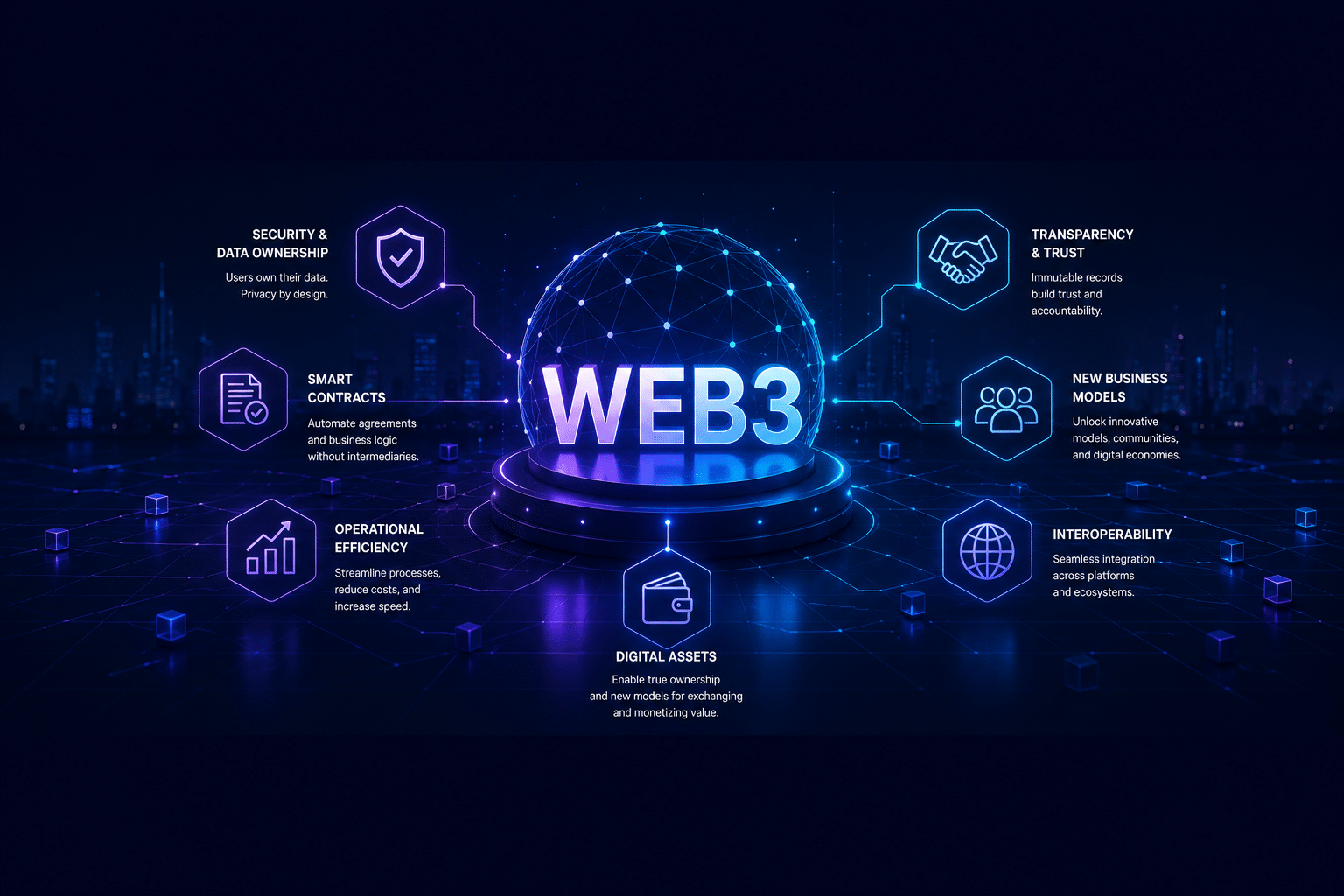
1. Increased Transparency and Trust
Blockchain-based systems create permanent records of transactions. For some industries, such a feature becomes a major competitive advantage.
In other words:
- Improved auditability
- Stronger process integrity
- Increased trust between parties
2. Smarter Automation Through Smart Contracts
Smart contracts enable predefined business rules to execute automatically. Automation becomes embedded directly into the transaction layer.
This approach can reduce:
- Manual verification
- Delays in processing
- Administrative overhead
- Dependency on intermediaries
3. Increased Resilience and Security
Decentralized architectures reduce single points of failure. When combined with robust cryptographic validation, Web3 apps can enhance the following aspects:
- Integrity of the data
- Resilience of the system
- Identity verification
Security moves away from focusing on the network’s edge and instead relies on building trust into the system itself.
4. New Customer Engagement Approach
Web3 application development enables companies to build more dynamic ecosystems centered around:
- Digital ownership
- Loyalty systems
- Participation of the community
- Tokenized incentives
This approach creates opportunities for stronger user engagement and long-term retention.
5. Improved Cross-Platform Interoperability
One big benefit of decentralized systems is portability. Transactions, identities, and assets can move more easily between platforms. This flexibility is becoming increasingly important as digital systems continue to evolve.
What This Looks Like in Practice
We’re already seeing practical use cases emerge across industries:
- Supply chain platforms are improving traceability and verification
- Financial applications that use smart contracts to reduce settlement friction
- Digital marketplaces enabling verified ownership of digital assets
- Enterprise ecosystems creating tamper-resistant audit trails
- Membership and loyalty programs are becoming more user-centric and portable.
Companies that benefit from Web3 are not just following trends. They are spotting real business problems and solving them in smart ways.
Challenges Are Real Too
Web3 application development has a lot of potential, but it is not a quick fix. There are still important things to consider:
- Uncertainty in regulations
- User onboarding complexity
- Scalability limitations in some blockchain ecosystems
- Integration challenges with existing enterprise systems
- Security considerations around smart contract development
This is why execution matters. Successful Web3 adoption requires thoughtful architecture, strong product strategy, and a clear understanding of where decentralization actually adds value. Not every problem needs a blockchain solution, but it makes some problems significantly easier to solve.
Final Thought
The future of Web3 application development is not about replacing the internet; it’s about creating more intelligent, transparent, and trusted digital ecosystems.
For businesses, the opportunity is not as simple as adopting emerging technology. It’s about recognizing how these technologies can boost productivity, increase customer confidence, and unlock entirely new business models. Companies that explore these technologies thoughtfully today will be better positioned for the next generation of digital experiences.
Frequently Asked Questions
1. What is Web3 application development?
Web3 application development focuses on building decentralized applications (dApps) using blockchain technologies, smart contracts, and distributed architectures.
2. How can Web3 benefit businesses?
Web3 can improve transparency, automate transactions, strengthen security, reduce dependency on intermediaries, and enable new digital business models.
3. Is Web3 only related to cryptocurrency?
No. While cryptocurrencies are part of the ecosystem, Web3 application development also includes decentralized identity, smart contracts, digital ownership, supply chain validation, and secure data-sharing systems.
4. What industries can benefit from Web3 application development?
Industries such as finance, logistics, healthcare, e-commerce, gaming, and digital marketplaces are already exploring practical Web3 use cases.
5. What are the most significant challenges in Web3 adoption?
Common challenges include regulatory uncertainty, scalability, user onboarding complexity, smart contract security, and integration with existing enterprise systems.
🔗 Keep Exploring
We’re constantly sharing what we’re learning in the field: real challenges, real solutions, and practical ideas you can apply to your business.
If you’re looking to go deeper, I invite you to explore more of our insights: Zunzun Solutions Blog


