


Releases shouldn’t feel like high-risk or dangerous events. Many teams deal with late nights, last-minute changes, uncertainty about potential production issues, and the awkward silence that follows a deployment while you wait to see if everything holds.
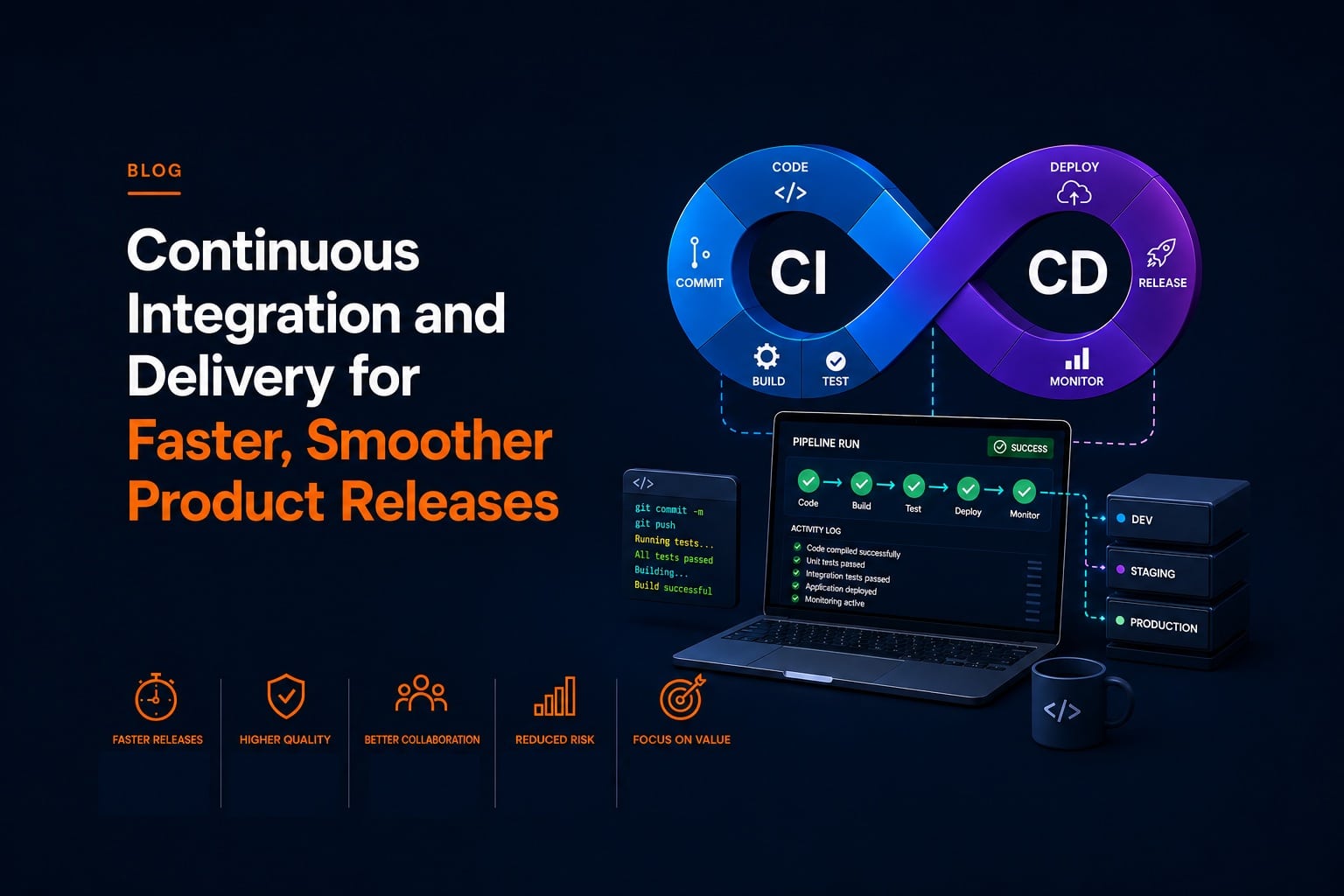
We’ve seen this pattern across companies of all sizes. And most of the time, it’s typically a system issue rather than a talent problem. Continuous Integration and Delivery (CI/CD) is specifically designed to address this issue.
Why This Matters More Than Ever
Speed is no longer a competitive advantage; it’s the baseline. Consumers anticipate seamless experiences, quick fixes, and continuous improvements. At the same time, systems are becoming more complex, and teams are becoming more distributed.
That combination creates pressure:
- Faster releases
- Keep up the quality
- Avoid disruption
Without the right foundation, those goals start to conflict with each other, whereas CI/CD aligns them.
The Real Challenges Behind Slow and Risky Releases
Prior to CI/CD, the majority of teams relied on non-scalable processes:
1. Manual and Inaccurate Deployments
Human intervention increases variability. Production problems can arise, even from minor inconsistencies.
2. Late Feedback Cycles
Testing is done too late in the process. Issues are identified when they’re more expensive to resolve.
3. Environment Inconsistencies
What works in staging doesn’t always work in production. Different configurations lead to unpredictable behaviors.
4. Coordination Bottlenecks
Releases require the perfect alignment of multiple teams. If one team is delayed, the whole process slows down.
5. Fear of Change
Teams deploy less frequently when releases are painful, which further increases risks.
Where Continuous Integration/Continuous Delivery Changes the Game
Continuous integration and delivery is more than automation. It’s a shift in how software is built and tested, as well as how the product is delivered.
1. Continuous Integration: Identify Issues Early
Every code change is automatically built and tested. Issues are fixed right away instead of piling up.
This means:
- Faster feedback for developers
- Fewer surprises later
- Higher code quality by default
2. Continuous Delivery: Always Ready to Release
Code is always ready to be deployed. Smaller changes = lower risks.
You can:
- Release on demand
- Reduce deployment friction
- Avoid “big bang” releases
3. Automation That Builds Confidence
Automation keeps things consistent from testing all the way through deployment.
Teams stop asking, “Did we miss something?” and start focusing on “What’s next?”
4. Faster Feedback Loops Across the Board
Continuous integration and delivery bring together development, QA, and operations. This helps quality and speed work together instead of against each other.
- Bugs are found earlier
- Performance issues become visible sooner
- Product decisions can be validated faster
What This Looks Like in Practice
When continuous integration and delivery is set up well, you see results right away:
- A product team transitioning from monthly releases to multiple deployments per day
- A company reducing production incidents by identifying issues earlier in the pipeline
- Engineering teams spending less time on manual processes and more on building value
This is not about moving faster just for the sake of speed. It’s about reducing friction throughout the delivery lifecycle.
It’s Not Just Tools but a Mindset
One of the biggest misconceptions is treating continuous integration and delivery as a tooling choice, when it’s clearly not. Even with the best pipelines, you can still run into problems if:
- Teams don’t trust the process
- Testing isn’t reliable
- Ownership is ambiguous
Continuous integration and delivery works when:
- Quality is part of the workflow and not a separate phase
- Teams are aligned around common goals
- Automation is intentional, not just added complexity
It combines product thinking, operational maturity, and engineering discipline.
Final Thought
The goal of continuous integration and delivery isn’t just to release faster. The goal is to release with confidence. Teams can transition from stressful, high-risk deployments to predictable, repeatable, and seamless releases with CI/CD… and when that happens, everything changes:
- Teams gain momentum
- Products evolve faster
- Customers notice the difference
Frequently Asked Questions
1. What is Continuous Integration and Continuous Delivery (CI/CD)?
CI/CD is a development approach where code changes are automatically integrated, tested, and prepared for release. It helps teams deliver software faster, with higher quality and fewer risks.
2. Why is CI/CD crucial for modern businesses?
With CI/CD, businesses can respond to customer demands more quickly, release updates more frequently, and minimize production problems. It transforms software delivery from a risky event into a consistent process.
3. How does continuous integration and delivery improve product quality?
By running automated tests on every change, CI/CD helps identify issues early in the development cycle. This reduces bugs in production and ensures more stable, predictable releases.
4. Is continuous integration and delivery only for large engineering teams?
No, teams of any size can profit from CI/CD. In fact, smaller teams often see faster impact because it reduces manual work and allows them to focus more on building value instead of managing releases.
5. What are the biggest challenges when implementing CI/CD?
Common challenges include setting up reliable automated tests, organizing teams around new workflows, and transitioning from manual to automated processes. Success requires both the right tools and the right mindset.
🔗 Keep Exploring
We’re constantly sharing what we’re learning in the field: real challenges, real solutions, useful concepts, and practical ideas you can apply to your business.
If you’re looking to go deeper, I invite you to explore more of our insights:
Read Latest News About Software Innovations