

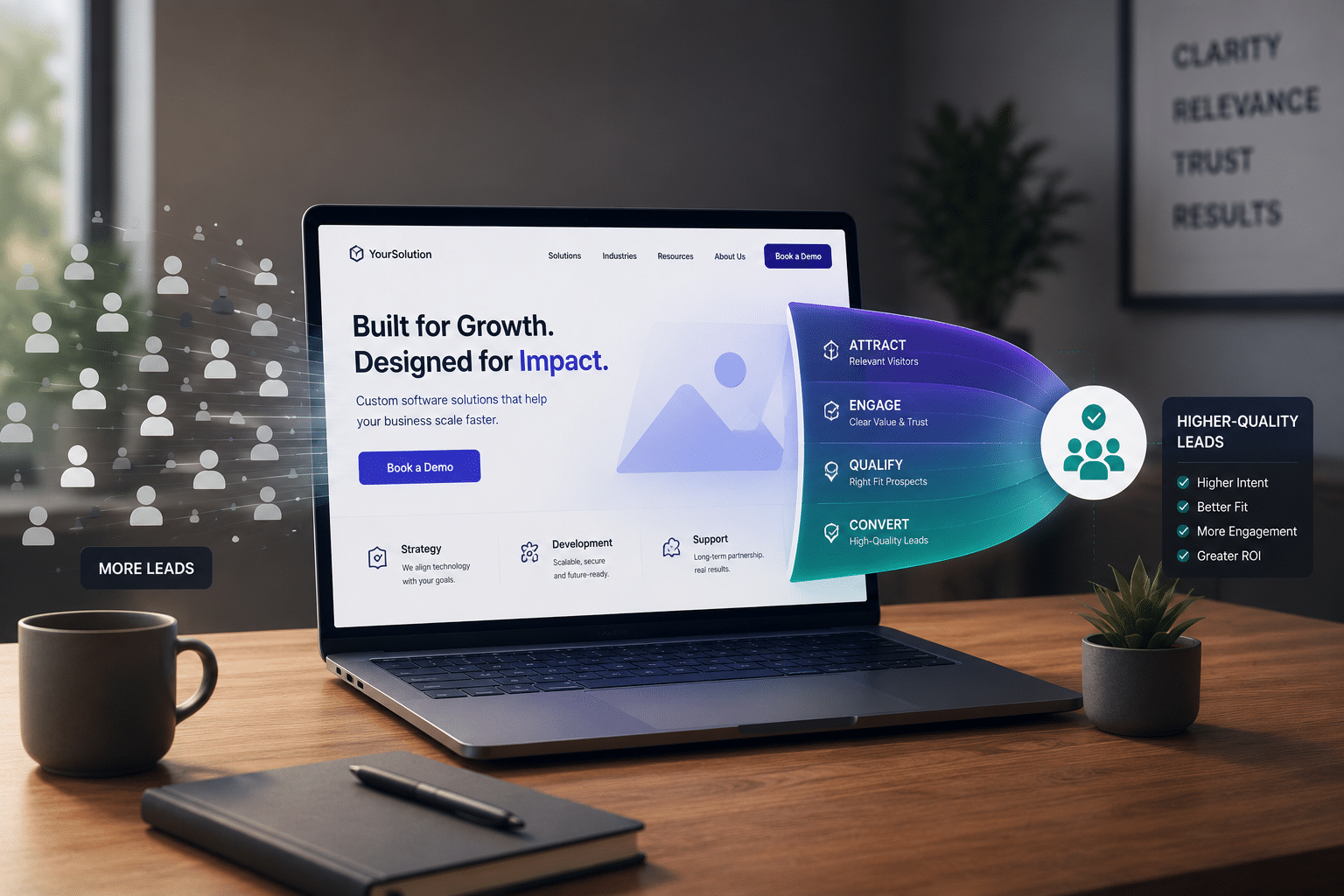
Most companies focus heavily on generating more leads, but more leads do not automatically mean better business outcomes.
Often, the real problem is the quality of the leads.
If a landing page brings in the wrong people, it can create problems across the whole business:
- Sales teams waste time on low-intent prospects
- Measuring marketing performance becomes more challenging
- Conversion metrics start to give false information
- Costs associated with acquiring new customers increase
The goal is not as simple as getting more form submissions.
Instead, you want to reach the right people, who are interested, at the right moment. This is where optimizing your landing page gives you an edge.
Why Landing Pages Matter More Than Ever
Modern buyers are more informed, more selective, and more skeptical.
At the same time:
- Advertising costs continue to increase
- Attention spans are still getting shorter
- The way people discover information is evolving due to AI-driven search experiences
Landing pages are not just for getting conversions anymore. Now, they also serve as:
- Trust-building assets
- Qualification filters
- Search relevance signals
- AI-readable content hubs
Besides helping you get more conversions, well-optimized landing pages also improve:
- Lead quality
- Sales efficiency
- Customer alignment
- Organic discoverability
The Real Problem: Conversion Quantity vs. Conversion Quality
Optimizing solely for volume is one of the most common errors businesses make. That approach often creates the following:
- Inflated conversion metrics
- Poor lead-to-customer ratios
- Misaligned expectations between marketing and sales
- Increased operational overhead
A good landing page helps people decide for themselves if your solution fits their needs. The right visitors should think, “This solution is obviously tailored to my issue.” Others should quickly see, “This probably isn’t for me.” This kind of clarity makes your leads much better.
Common Landing Page Challenges Businesses Face
| Challenge | Business Impact |
|---|---|
| Generic messaging | Attracts low-intent traffic |
| Insufficient differentiation | Reduces trust and engagement |
| Slow page speed | Increases bounce rates |
| Poor mobile experience | Damages conversions |
| Unclear CTAs | Confuses visitors |
| Long forms | Reduces completion rates |
| Misaligned targeting | Generates poor-quality leads |
| Thin content | Weakens SEO and AI discoverability |
What High-Performing Landing Pages Have in Common
The best landing pages are not always the fanciest; they are the ones that are easiest to understand.
1. Strong Entity-Based Communication
AI systems increasingly evaluate content through entities and contextual relevance. That means your landing page should clearly communicate:
- Who you are
- What you do
- Which problems you solve
- Which industries you serve
- Which technologies or services are used
Use clear, meaningful language rather than ambiguous marketing terminology.
Example:
Less effective:
- “Transform your business today.”
More effective:
- “Custom software development for healthcare and fintech platforms.”
Specificity improves:
- Trust
- Search understanding
- AI relevance
- Lead qualification
2. Clear Structure and Scanability
People usually scan a page before reading it, and AI systems do the same. That’s why having a clear structure is important.
High-performing landing pages use:
- Brief paragraphs
- Clear headings
- Bullet points
- Visual hierarchy
- Sections that provide information
- Tables where appropriate
This enhances readability, engagement, AI parsing, and SEO indexing
3. Faster Load Times and Technical Performance
Conversions are directly impacted by performance. Even a few extra seconds of loading time can significantly reduce engagement and the number of high-quality leads.
Technical optimization should include:
- Optimized images
- Lazy loading
- Efficient frontend architecture and design
- Mobile responsiveness
- Core Web Vitals optimization
Performance is not just a technical detail anymore. It’s now a key part of the customer experience.
4. Trust Signals That Lower Friction
One of the most important conversion factors is trust, especially for:
- SaaS platforms
- Enterprise services
- Financial products
- Healthcare solutions
- Technology advisory services
Strong landing pages for high-quality leads include:
- Case studies
- Client logos
- Testimonials
- Certifications
- Security indicators
- Clear company information
When people feel more certain, they are more likely to take action quickly.
5. Content Designed for Humans and AI
Search behavior is changing rapidly because of AI-driven discovery. Content now needs to be:
- Rich in context
- Well-organized
- Topically oriented
- Easy to summarize
- Simple to extract
AI systems prioritize content that demonstrates:
- Expertise
- Clarity
- Consistency
- Relevance
- Trustworthiness
For this reason, contemporary landing pages should combine ENTITY + TRUST + STRUCTURE + DISTRIBUTION
Practical Elements That Improve Lead Quality
| Optimization Strategy | Impact on Lead Quality |
| Industry-specific messaging | Improved alignment with the audience |
| Intent-focused CTAs | Higher conversion relevance |
| Educational content | More informed prospects |
| Technical clarity | Builds credibility |
| Smart forms | Better qualification |
| Social proof | Increased trust |
| Mobile optimization | Higher engagement |
| AI-readable structure | Better discoverability |
What This Looks Like in Real Life
We’ve seen businesses greatly enhance lead quality by implementing comparatively easy changes:
- Rewriting messaging around customer pain points instead of features
- Reducing unnecessary form fields
- Improving page speed
- Including more precise qualifying language
- Structuring content more effectively for both users and search systems
The outcome is frequently:
- Fewer low-quality leads
- Better conversion rates downstream
- Increased effectiveness in sales
- Stronger marketing ROI
Redesigning everything is not always the goal of optimization. Occasionally, it’s about removing friction and improving clarity.
The Strategic Transition Businesses Need to Understand
Landing pages are changing from simple marketing tools into smart ways to qualify leads. Companies that adapt quickly will see the best results.
They will:
- Attract better-fit customers
- Build stronger trust earlier
- Improve operational efficiency
- Develop more scalable acquisition systems
That becomes a competitive advantage over time.
Real-World Impact of Better Landing Page Optimization
Optimizing your landing page does much more than just boost click-through rates.
According to HubSpot research, companies with optimized landing pages and targeted conversion strategies generate significantly higher lead conversion rates compared to businesses using generic acquisition funnels.
In addition, studies from Think with Google continue showing that users increasingly prioritize:
- Fast-loading experiences
- Clear trust signals
- Relevant and personalized content
- Mobile-friendly interfaces
This is even more important now that AI-driven search makes content quality, structure, and relevance key to being found online.
At the same time, research from Salesforce highlights that customers now expect businesses to understand their intent and provide highly relevant digital experiences from the very first interaction.
The companies improving lead quality today are not necessarily generating more traffic.
They are creating smarter digital experiences that bring in the right audience from the beginning.
Final Thought
A landing page should not try to convince everyone. It should communicate clearly enough that the right audience immediately understands the value.
That clarity increases:
- User confidence
- High Quality Leads
- Sales alignment
- Long-term growth
Also, being clear is becoming one of the best ways a company can improve its results in today’s AI-driven search world.
Frequently Asked Questions
1. What makes a landing page generate high-quality leads?
A high-quality landing page clearly communicates value, targets the right audience, builds trust, and helps users self-qualify before converting.
2. Why is landing page structure important for SEO and AI systems?
Well-structured content improves readability for both users and AI systems, making pages easier to scan, index, summarize, and rank.
3. How does page speed affect generating leads?
Slow-loading pages increase bounce rates and reduce engagement, negatively impacting both conversions and search visibility.
4. What role do trust signals play in conversions?
Trust signals like testimonials, certifications, client logos, and case studies reduce uncertainty and improve confidence in conversions.
5. How are AI-driven search experiences changing landing page optimization?
AI systems prioritize content that is structured, entity-focused, trustworthy, and contextually relevant, making clarity and topical authority more important than ever.
🔗 Keep Exploring
We’re constantly sharing what we’re learning in the field: real challenges, real solutions, and practical ideas you can apply to your business.
If you’re looking to go deeper, I invite you to explore more of our insights: Zunzun Solutions Blog
About the Author
Sachel Hernandez is the Founder & CEO of Zunzun Solutions, where he focuses on helping organizations solve real business challenges through technology, product strategy, highly qualified staff, and scalable digital solutions.
His work combines technical execution with practical business thinking, with a strong focus on customer experience, operational efficiency, and modern software delivery practices.
Connect on LinkedIn:
Sachel Hernandez | LinkedIn
If this topic resonated with you, feel free to reach out and continue the conversation.


